

Amitabha Buddha's Eye | Light of the Pure Land · Compassionate Illumination
Amitabha Buddha's Eye | Light of the Pure Land · Compassionate Illumination
Couldn't load pickup availability
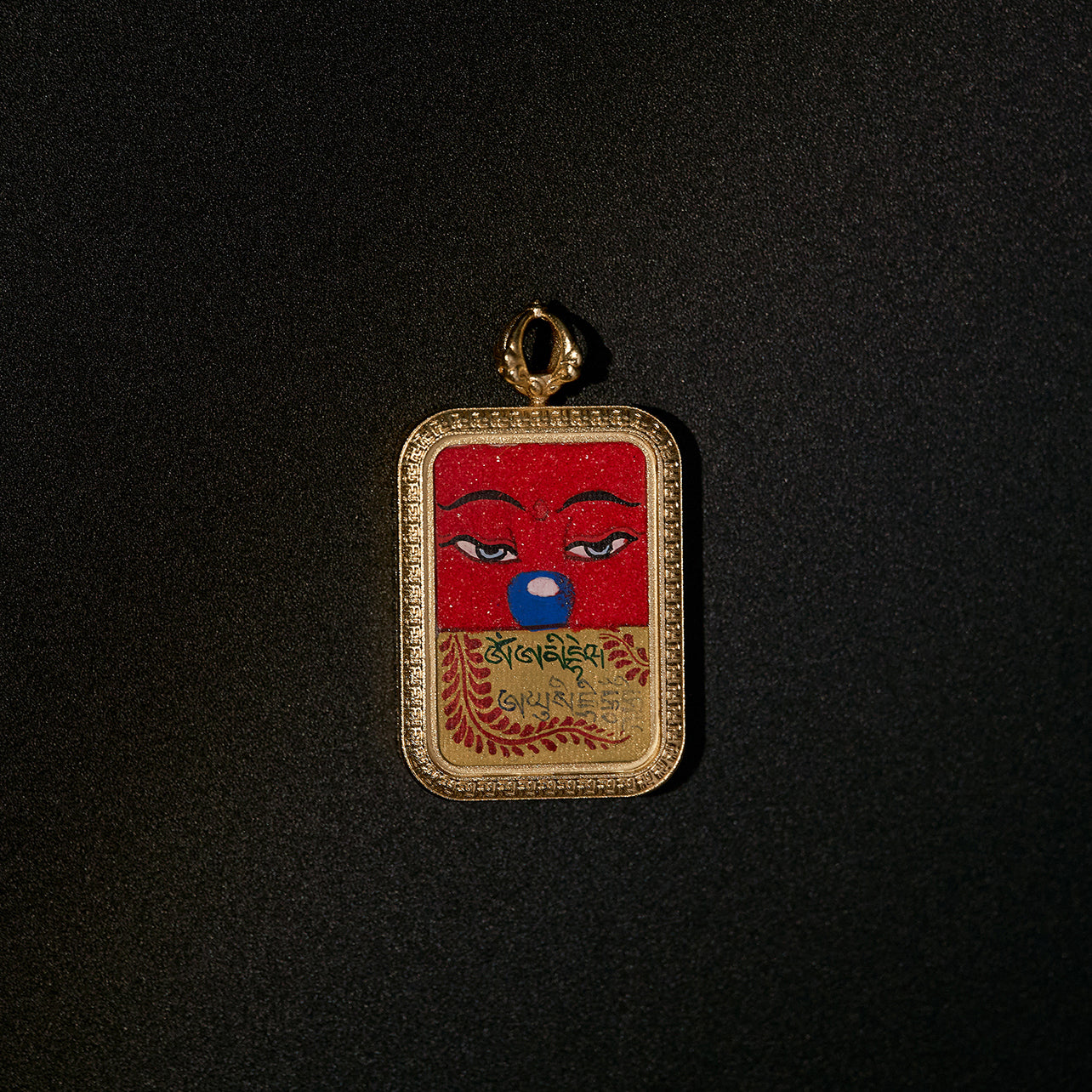
Amitabha Buddha's Eye - Gold Edition
【Artistic Connotation: Wise Observation, Perfect Mantra】
-
Compassionate Observation: The top of the artwork features a micro-painting of a profound and serene "Eye of Wisdom," symbolizing a gaze that transcends time and space in artistic imagery. It aims to bestow a silent warmth upon the wearer, safeguarding inner peace and steadfastness.
-
Unity of All Things: Azure blue dots (symbolizing the core of Buddhist teachings) are interspersed between the Buddha's eyes, set against a rich cinnabar red background. This signifies the convergence of supreme wisdom and the beautiful vision of harmonious coexistence of all things.
-
Mantra Aesthetics: The lower part of the artwork precisely outlines sacred Tibetan mantras, complemented by delicate Tang grass patterns. The power of the words and the aesthetics of the image merge here, presenting a dual artistic expression with strong visual tension.
【Intangible Cultural Heritage Craftsmanship: Millennia-Old Strokes, Natural Mineral Colors】
-
Hand-painted by Artisans: Reverently hand-painted by senior artisans from the holy Samye Monastery in a state of tranquility. Every layer of line and color blend strictly adheres to the intangible cultural heritage thangka rituals, preserving profound cultural heritage within the small painting core.
-
Natural Mineral Pigments: Insists on using precious natural minerals such as cinnabar, lapis lazuli, and gold powder as pigments. These colors derived from the earth not only resist fading over time but also give the artwork a serene and profound artistic texture.
-
Micro-painting Techniques: Within an extremely miniature format, mantras and the spiritual essence of the Buddha's eye are precisely depicted with extremely fine brushstrokes. This "microscope-level" craftsmanship represents the high level of achievement in Tibetan Buddhist miniature thangka art.
【Applicable Vision: Inspiring Wisdom, Smooth Success】
-
Opening Wisdom: Especially suitable for individuals in important academic stages, career decision-making periods, or life turning points. It aims to help discern the essence of things and break through mental fog through artistic contemplation.
-
Protection and Peace: The Buddha's eye imagery symbolizes protection and awareness, making it suitable as an everyday "protective charm." It aims to alleviate environmental pressure, calm inner restlessness, and safeguard present stability.
-
Auspicious Blessings: The luxurious and grand golden precision casing, along with the red and gold color scheme, embodies a high-end Eastern aesthetic. Wearing it on the chest is not only a reflection of aesthetic taste but also an auspicious gift to wish for a prosperous and successful life.
What you will get and the policy
You will receive a total of 3 items.
-

Your chosen Guardian Thangka
-

Tibetan Necklace - For Wearing Cards
-

Free Bracelet - Natural African Jade Bracelet


‼️ Delivery and Policy
❗️Inventory status and shipping time
- Our Thangka inventory is limited and diverse . If the selected Thangka is in stock, we will process and ship it within 15-20 days.
- If the Thangka is out of stock, it will be hand-painted by our artists , which may take 50-60 days to complete. We will contact you to confirm if you are willing to wait for the customization to be completed.
❗️Policy
- We offer a 24-hour refund policy . You can request a refund within 24 hours of placing your order. After 24 hours, we will no longer process refund requests.
- Due to the high cost of Thangka production , no discounts or coupons are available . Thank you for your understanding.
Why is this Thangka so precious?
Rare mineral pigments

Gold leaf
Gold leaf is made from high-purity gold and hammered into ultra-thin sheets. Its luster is not "golden paint," but a true metallic sheen, possessing a depth and reflective effect that only gold can provide.
On Thangkas, gold is typically applied using the traditional gilding technique: first, a thin layer of adhesive is applied, then gold leaf is placed on top and gently polished, and finally, the edges are refined with an extremely fine brush to make the decorations, halos, and sacred details stand out even more.

银
The silver used in Thangka making was originally a refined precious metal. It was either hammered into paper-thin silver foil or processed into pigment-grade silver powder—both methods incurred actual material costs and waste.
The key to making silver powder usable as a "pigment" lies in its preparation process: the silver powder must be hand-ground to an extremely fine fineness, then repeatedly sieved and graded to remove coarse particles and impurities, ultimately retaining only the most uniform particles. The quality requirements for silver powder are extremely stringent—if the powder is not fine enough, it will appear coarse; if the lines are not smooth enough, they are difficult to correct—therefore, creating clean and crisp silver details requires a significant investment of time, skill, and cost, all of which are tangible.

turquoise
Turquoise typically forms in the form of fine veins; dense, clean, and richly colored turquoise is relatively rare, and this stone can crack—losses are a real possibility during mining and selection.
After being washed, crushed, and hand-ground, the particles are then separated by water washing and grading through sedimentation to separate finer and clearer particles; the finest part is glued together with bone glue and spread into a thin layer to form a bright, transparent blue-green color.

pearl
The value of a pearl lies not only in its white color—it also in the soft iridescent luster emanating from the microscopic structure of the nacreous layer, which is worn away by coarse polishing, turning it into a chalky color.
This is why Thangka-grade pearls are washed, dried, ground very finely, graded, and then bonded together with bone glue to form a thin layer of pearlescent glaze—so that the light appears to come from within, rather than being painted on.

Saffron
Though saffron is as red as fire, the extracted dye is a translucent golden yellow, naturally vibrant and incredibly penetrating. However, the quality of the pigment depends on the origin and purity of the stigmas – the deeper red and plumper the pistils, the brighter and purer the extracted color. This transparency is something mineral pigments cannot replicate. As a core botanical pigment in Thangka, its color spectrum spans a vibrant range from bright yellow to orange-yellow.
After soaking in warm water or decocting to extract its essence, the highest quality saffron dye needs to be combined with an appropriate amount of bone glue and applied to the canvas through multiple layers of blending. It not only imbues the skin of Buddhist figures or monastic robes with a sacred texture but also carries a pure blessing power and a faint fragrance due to its natural medicinal properties. Visually, it's as if a warm, compassionate light radiates from within the canvas.

malachite
Malachite has a naturally saturated green color, but pigment-grade quality depends on cleanliness—impurities will dull the hue, and uneven particles will make the surface rough, so selection is important.
After repeated grinding and grading, the highest quality malachite is bonded together with bone glue and layered thinly to form a dense, mineral-green color that looks as if it grew out of the stone.

Cinnabar
Cinnabar is highly regarded for its bright, pure vermilion color—but it is ruthless: impurities or coarse particles can quickly dull or coarse the red.
That's why it needs to be ground very finely, graded repeatedly, bound with bone glue, and applied in thin, controlled layers to maintain a crisp, pure red color.

lapis lazuli
Lapis lazuli is expensive not only because it is a gemstone, but also because the truly "blue" core is relatively rare—people select the deep blue part and then remove the light-colored matrix.
Its signature step is purification: in addition to simple precipitation, traditional preparation methods also involve binding crushed lapis lazuli into blocks and repeatedly washing/kneading them to release different grades of blue particles; then the finest and purest part is bound with bone glue and layered to obtain a deep, gem-like blue.

coral
In many regions, the availability of coral is limited, so pigment-grade materials are often expensive and rely on responsible sourcing and careful selection.
After being cleaned, dried, and finely graded, the coral takes on a warm, fleshy red color, best suited for a thin layer—rich yet understated.
视频
Frequently Asked Questions
Even if I am not a Buddhist, can I still buy Thangkas?
Yes. Many collectors and art enthusiasts appreciate the exquisite craftsmanship, symbolism, and cultural heritage of Thangkas. We encourage the display of Thangkas with respect and the learning of this tradition.
Do I have to choose based on my zodiac sign? Or can I choose based on its meaning?
You can choose based entirely on the meaning. The constellation is just a starting point—you are free to choose a guardian deity that resonates with you, such as wisdom, compassion, protection, purification, strength, peace, and so on.
How should I choose a gift if I don't know the recipient's zodiac sign?
If you're unsure of their zodiac sign, you can choose a guardian deity with a more universal symbolic meaning (such as compassion, wisdom, or peace), or select a style based on their preferred color and design. You can also leave a message at checkout indicating that this is a gift, and we'll try our best to recommend suitable options for you.
Is this Thangka hand-painted?
Yes. Every Thangka we offer is 100% hand-painted by highly skilled artists from Tibet. Because each Thangka is handmade, the one you receive may differ slightly from the photo on the page—this is precisely what makes each Thangka unique.