Skip to product information
1 of 4

【Collection of Jade Beads】 Free and Interesting Bracelet

【Collection of Jade Beads】 Free and Interesting Bracelet

Regular price $48.00 USD
Regular price Sale price $48.00 USD
Sale Sold out
Shipping calculated at checkout.
Quantity

Natural quartz jade/African emerald crystal (random shipment)

— Dewy green fields, glistening and swirling, a vibrant life force flowing across the wrist —


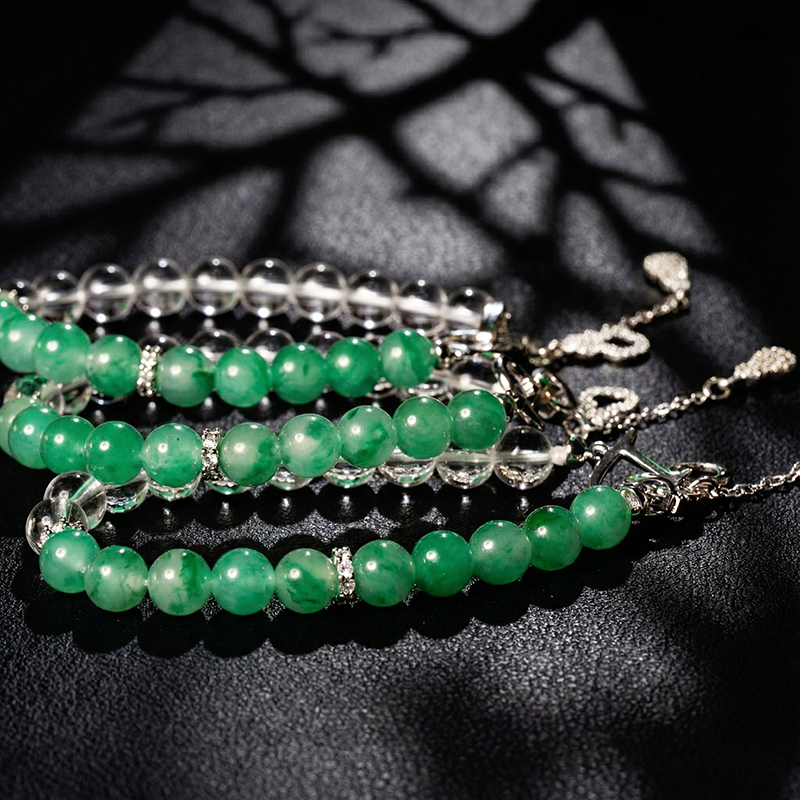
The elegant African jade, with its lush, vibrant forest hues, embodies the earth's vibrant life force; while the translucent crystal is like a wisp of mist in the mountains at dawn. This DIY bracelet cleverly combines these two naturally beautiful materials, breaking away from the monotony of traditional single-strand bracelets. The layered design showcases a light and airy "new Chinese" aesthetic. Between the bright green and pristine white, it aims to lock in a sense of freshness and joy, like a gentle breeze after a forest rain, amidst the hustle and bustle of city life.


Product Core Details

  • Exquisite African Jadeite with Icy Colors : Selected high-quality natural African jadeite (quartz jade), its color presents a rich and full emerald green, full of vibrant life force.

  • Crystal clear white crystal and translucent texture : The natural white crystal beads that are paired with it are pure and transparent, as clear as ice cubes, which greatly enhances the visual brightness and coolness of the overall accessory.

  • Flexible DIY Design and Layering Aesthetics :

    • Multi-layered design : The multi-layered design not only enhances the lines of the wrist but also creates a rich visual effect.

    • Exquisite gourd pendants : Each string is adorned with a finely crafted metal gourd pendant (symbolizing "good fortune and prosperity"), and is densely inlaid with rhinestones in the details, injecting a touch of modern light luxury into the rustic style.

  • Precision polishing and comfortable touch : Each bead undergoes rigorous hand polishing, resulting in a mirror-like surface that feels cool and smooth to the touch, ensuring an excellent skin feel when worn.

  • Diverse shipping options, serendipitous encounters : Due to the natural texture of jade and the randomness of DIY, each bracelet has slight differences in the depth of green color, the clarity of the crystal, and the details of the accessory distribution. What you possess is a unique and precious connection.


Applicable Scenarios

  • Perfect accessories for a natural, bohemian, and artistic style : their fresh and refined color scheme is perfect for pairing with white cotton and linen skirts, modern Chinese-style shirts, or elegant knitwear, instantly brightening the complexion and showcasing an intellectual temperament.

  • Stress-relieving touches during your commute : In the midst of a busy workday, gently twirl a warm, jade bead on your wrist and feel the energy derived from the forest and ice crystals. This can help soothe your emotions and restore inner peace.

  • A heartfelt gift for your best friend : emerald green represents hope, and the gourd symbolizes good fortune. Presenting this "lucky" themed item from the brand's collection to a friend conveys a romantic wish for "everlasting happiness and all things going well."


"Emerald shadows brush your wrist, dewdrops glisten." May this DIY African emerald crystal bracelet accompany you through the hustle and bustle of the world, allowing you to feel the tranquility and contentment of nature with every gesture.

View full details

What's Included & Our Policies

  • Your Chosen Guardian Thangka

  • A Tibetan Necklace for Wearing Your Thangka

  • A Complimentary Natural African Jade Bracelet

‼️ Shipping & Policies

❗️Availability & Dispatch Times

  • Our thangka inventory is limited and varied. If your chosen thangka is in stock, we will process and dispatch it within 15–20 days.
  • If it is out of stock, it will be hand-painted by our artists, which may take 50–60 days. We will contact you to confirm whether you are willing to wait for the custom piece to be completed.

❗️Policies

  • We offer a 24-hour refund policy. You may request a refund within 24 hours of placing your order. Refund requests will no longer be accepted after 24 hours.
  • Because thangkas are costly to produce, they are not eligible for discounts or coupons. Thank you for your understanding.

What Makes This Thangka So Precious

Rare Mineral Pigments

Gold Leaf

Gold leaf is made from high-purity gold, hammered into exceptionally thin sheets. Its glow is not “gold-colored paint,” but the true luster of metal, with a depth and reflection that only gold can provide.

On thangkas, gold is typically applied using traditional gilding techniques: a thin layer of adhesive is laid down, the gold leaf is placed and gently burnished, and an extremely fine brush refines the edges to highlight ornaments, halos, and sacred details.

Silver

The silver used in thangka making begins as a refined precious metal. It is either hammered into paper-thin leaf or processed into pigment-grade powder. Both methods involve real material costs and losses.

The preparation is what makes silver powder usable as “paint”: it is ground by hand to an extremely fine consistency, then repeatedly sifted and graded to remove coarse particles and impurities, leaving only the most uniform grains. Silver demands exacting quality. Powder that is not fine enough appears rough, and uneven lines are difficult to correct. Creating clean silver details therefore requires a visible investment of time, skill, and cost.

Turquoise

Turquoise usually forms in narrow veins. Dense, clean, richly colored material is relatively rare, and the stone can fracture, creating real losses during mining and selection.

It is washed, crushed, and ground by hand, then separated through washing and sedimentation to obtain finer, clearer particles. The finest fraction is bound with animal glue and applied in thin layers to create a bright, translucent blue-green.

Pearl

A pearl's value lies in more than its whiteness. The microscopic structure of its nacre produces a soft iridescent glow, which coarse grinding can reduce to a chalky color.

That is why pearls prepared for thangka painting are washed, dried, ground exceptionally fine, graded, and then bound with animal glue into a thin pearlescent glaze. The light appears to come from within rather than being painted on.

Saffron


Although saffron threads are fiery red, their extract is a clear, luminous golden yellow with a natural translucency. Pigment quality depends on the origin and purity of the threads: the deeper red and fuller the stigmas, the brighter and purer the extracted color. Mineral pigments cannot replicate this transparency. As a principal plant pigment in thangka painting, saffron offers a vibrant range from bright yellow to orange-yellow.

The essence is extracted by soaking in warm water or simmering. The finest saffron extract is combined with an appropriate amount of animal glue and built up in layers of shading on the canvas. It gives the skin of sacred figures and monastic robes a luminous quality. Its traditional medicinal associations and gentle fragrance also give it a sense of purification and blessing, as though warm, compassionate light shines from within the canvas.

Malachite

Malachite has a naturally saturated green, but pigment-grade quality depends on purity. Impurities dull its color, and uneven particles create a rough surface, making careful selection essential.

After repeated grinding and grading, the finest malachite is bound with animal glue and applied in thin layers, producing a dense mineral green that seems to emerge from the stone itself.

Cinnabar

Cinnabar is prized for its vivid, pure vermilion red, but it is unforgiving: impurities or coarse particles quickly make the red look dull or rough.

That is why it is ground extremely fine, repeatedly graded, bound with animal glue, and applied in thin, controlled layers to keep the red crisp and pure.

Lapis Lazuli

Lapis lazuli is expensive not only because it is a gemstone, but also because the mineral that produces its true blue is relatively scarce. Deep-blue areas are selected and the pale surrounding matrix is removed.

Purification is the defining step. Beyond simple sedimentation, traditional preparation involves binding ground lapis into a mass, then repeatedly washing and kneading it to release different grades of blue particles. The finest, purest fraction is then bound with animal glue and layered to produce a deep, gemstone-like blue.

Coral

Coral sourcing is restricted in many regions, so pigment-grade material is often costly and depends on responsible sourcing and careful selection.

After washing, drying, and fine grading, coral produces a warm, fleshy red that works best in thin applications: rich yet understated.

Video

Frequently Asked Questions

Can I buy a thangka if I am not Buddhist?

Yes. Many collectors and art lovers appreciate thangkas for their craftsmanship, symbolism, and cultural heritage. We encourage respectful display and learning about the tradition.

Do I need to choose by zodiac sign, or can I choose by meaning?

You can absolutely choose by meaning. Your zodiac sign is simply a starting point. You are free to choose a guardian whose qualities resonate with you, such as wisdom, compassion, protection, purification, strength, or peace.

How do I choose a gift if I don't know the recipient's zodiac sign?

If you are unsure of their zodiac sign, choose a guardian with a more universal meaning, such as compassion, wisdom, or peace, or select a piece based on their preferred colors and style. You can also leave a note at checkout to let us know it is a gift, and we will do our best to suggest a suitable design.

Is this thangka hand-painted?

Yes. Every thangka we offer is 100% hand-painted by skilled artists from Tibet. As each piece is handmade, the thangka you receive may differ slightly from the photographs on this page. That is part of what makes every work unique.